
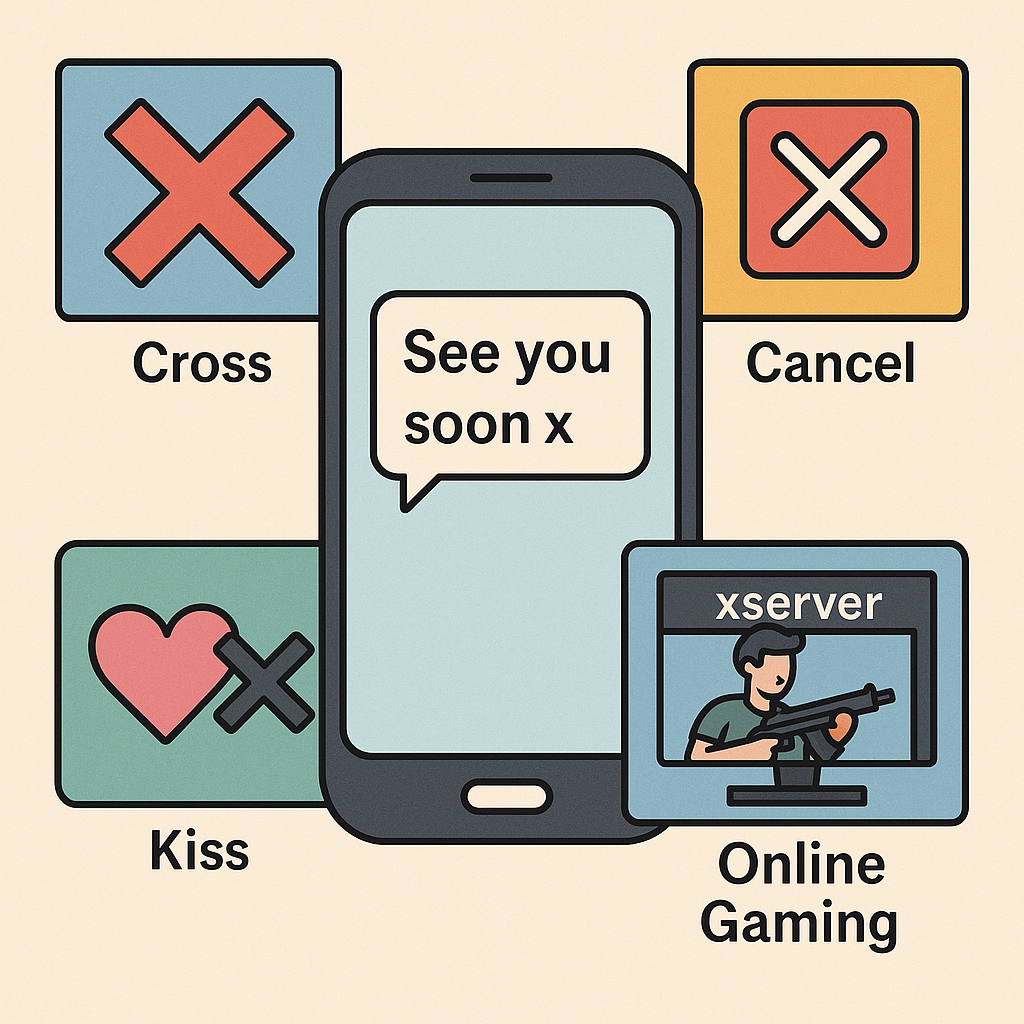
Did you ever get a “see u soon x” message and wonder where the ‘x’ was coming from? Have you ever in a game when the term “xserver” would appear with a puzzled face in inquiry as to what it was? The “x” does not occur as a normal letter. We can use this letter in the online community as “hug and kiss,” use it as a sign for “crossing” something, and it is used when describing a special style or tone in a chat.
In digital communication, these are not merely style or abbreviation issues, but also issues of language strategy. On a phone, by typing “x,” individuals can convey emotion, politeness, and social identity in a way they would not if they were writing with full words. Interestingly, the pragmatics of “x” can differ based on who uses it, where they use it, and in what situation.
English as a global language is not just a communication device used around the world but also evolves with the wave of technology and globalization. As electronic communication becomes more and more a part of everyday interaction, especially across media like social media, online games, and instant messaging programs, English expands by adopting new expressions, abbreviations, and symbolic forms created in these electronic environments. For example, English dialect employed to convey emotion, tone, or intent, loosely termed “shorthand,” have been pragmatically re-configured. Slang terms like “LOL” (laugh out loud), emojis, or symbols like the letter “x” are doing more than their face-value meanings. This is due to synergy among cultural, language, and communications technology evolution.
The English language evolves as technology develops In its path of development, English adopted a great deal from the languages, and new ones were also developed, such as the use of symbols or alphabets as representatives of a designated meaning. For instance, the use of the letter “x,” originally as a rejection sign, is also employed today as a representative of the term “cross” in real as well as virtual contexts. In the real world, we find words such as “ped-xing” used for crossing by pedestrians in traffic signals, or they are used in virtual contexts such as ‘xserver’ for cross-server or “xcountry” for cross-country.
The use of the letter “x” in text messaging is not a syntactic marker as in Japanese, e.g., the particle か (ka), used as a marker of an interrogative sentence. The digital variety of English borrowed the letter “x” as a token or a pragmatic meaning marker, highly dependent on the cultural, social, and platform use environment. For instance, a trailing “x” in a text message in Britain is “kiss” or a friendly closing sign, appropriately interpreted by a friend or a partner as a friendly hug or a kiss “Good night x”. On the contrary, “x” can also signify ‘dismiss’ or “cancel” in a different environment: “I used to calculate it a good plan, but then x.” It is also used occasionally as a style marker, giving a sarcastic, ignorant, or even a playful tone subject to the tone of discussion and relationship of speakers.
Aside from its use in daily social conversation, the “x” symbol has become a readily visible feature in text-based digital conversation within chat rooms, online forums, or video games. In digital domains of conversation, “x” is also used frequently in shortened words expressing ‘over’ or ‘across.’ This shows how language users find efficient ways to get their point across, especially in situations that require efficiency. For example, in video games with a server switch feature, players use sentences such as “They will xserver to here soon” in conveying the idea that other players or game characters are cross-servering to where they are.
The development in the use of the “x” symbol in text messaging can be viewed as evidence of language constantly changing in response to meeting its users’ requirements. The symbol not only serves as a shortening of words but also as a sign of shared meaning within a group of users. This contrast illustrates that symbols in online communications are of a higher pragmatic value as they are used in a setting, for a purpose, and in relation to the social relation between the communicators. The interpretation of the use of the “x” symbol in text messaging not only avoids misunderstanding but also illustrates how this single symbol can reflect politeness strategies, language economy, and group identity.
The use of the “x” symbol as a marker of various meanings in English proves that new linguistic forms can emerge and evolve along with changes in the way humans communicate. This symbol is no longer a letter or a symbol in itself, but a component of a pragmatic digital system with multiple meanings in contexts. Having learned such dynamisms, we are not merely language users according to adaptations, but more open in response to social change in cross-platform contexts.
the author named Pandu Aryo, a student of English Literature in Andalas University. Born on October 17, 2003 in Jakarta. Besides being busy studying, author also active in UKMF LPK FIB, which is a student creativity center engaged in creative writing.




Leave a Reply